


This article explores in depth the types of solar inverters suitable for small-power water pumps, aiming to provide accurate inverter selection references for agricultural irrigation, small-scale industrial water supply, and home courtyards, and help achieve efficient energy utilization and water pump drive with low-cost investment.
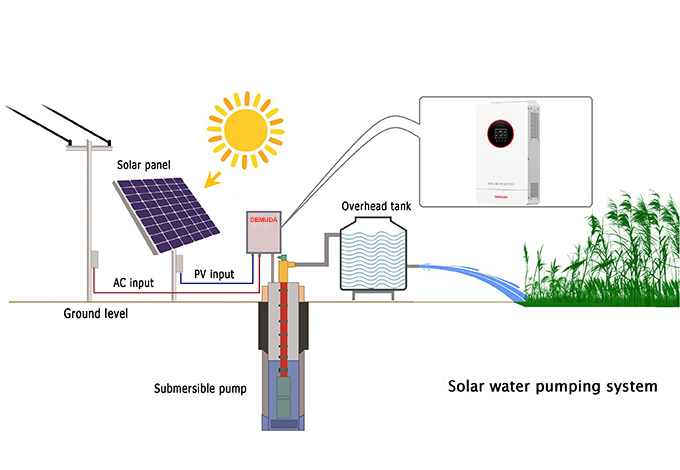
1. Types of solar inverters that can drive water pumps
1.1 DC pump dedicated inverter (DC-DC drive)
●Working principle:
DC pump dedicated inverter (also known as DC-DC controller) is directly connected to the solar panel, without the need for batteries or AC conversion, and optimizes the output of the photovoltaic array through the MPPT (maximum power point tracking) algorithm to match the voltage and current requirements of the DC water pump (such as permanent magnet brush less DC motor).
●Advantages
✅ High efficiency (>95%), no AC-DC conversion loss
✅ Low cost, no battery or complex inverter circuit required
✅ Maintenance-free, simple system, high reliability
●Disadvantages
❌ Only applicable to DC water pumps, low compatibility
❌ Dependent on sunshine, cannot work on rainy days (unless combined with energy storage)
●Cost-benefit analysis
Project | Cost (example) | Benefits |
Inverter cost | ¥500-3000 (depending on power) | Long-term electricity savings, no grid dependence |
PV panel cost | ¥2-4/W | Low maintenance, life span 20+ years |
Water pump cost | ¥1000-5000 | High efficiency and energy saving, suitable for remote areas |
Total cost (1kW system) | ¥8000-15000 | Payback period 3-5 years |
1.2 AC water pump inverter (DC-AC inverter)
●Working principle
Convert solar DC power into AC power (220V single-phase or 380V three-phase) to drive standard AC asynchronous motor or permanent magnet synchronous motor water pump.
●Classification
Single-phase inverter (220V): suitable for household or small water pumps (<3kW)
Three-phase inverter (380V): suitable for industrial high-power water pumps (>3kW)
●Applicable scenarios
Agricultural irrigation (such as centrifugal pumps, submersible pumps)
Municipal water supply, industrial circulating water system
●Advantages
✅ Compatible with commercially available standard AC water pumps, with a wide range of choices
✅ Can be used with power grid or diesel generator backup
●Disadvantages
❌ Low conversion efficiency (85-93%)
❌ Need to match motor power, high-power models are expensive
●Cost-benefit analysis
Project | Cost (example) | Benefits |
Inverter cost | ¥2000-10000 (single phase) | Can drive standard water pumps, easy maintenance |
PV panel cost | ¥2-4/W | Suitable for high power demand |
Water pump cost | ¥2000-10000 | Wide market, low maintenance |
Total cost (5kW system) | ¥25000-50000 | Payback period 5-7 years |
1.3 Inverter for photovoltaic water pump (including MPPT)
●Working principle
Designed specifically for solar water pumps, integrated MPPT algorithm, dynamically adjusts voltage/current, and maximizes solar energy utilization.
●Applicable scenarios
Agricultural irrigation (drip irrigation, sprinkler irrigation)
Deep well pumping in desert areas
●Advantages
✅ Highest efficiency (>98%), optimized photovoltaic output
✅ Soft start, reducing mechanical shock of water pumps
●Disadvantages
❌ Higher price (20-30% more expensive than ordinary inverters)
●Cost-benefit analysis
Project | Cost (example) | Benefits |
Inverter cost | ¥3000-15000 | Improve photovoltaic utilization by 20%+ |
PV panel cost | ¥2-4/W | Reduce the number of solar panels required |
Total cost (4.2kW system) | ¥15000-30000 | Investment payback period 4-6 years |

1.4 Hybrid inverter (PV + grid/battery)
●Working principle
Can switch between solar, grid or battery power to ensure that the water pump runs around the clock.
●Applicable scenarios
24-hour water supply for households
Greenhouse planting, aquaculture
●Cost-benefit analysis
Project | Cost (example) | Benefits |
Inverter cost | ¥5000-20000 | High reliability, suitable for critical applications |
Battery cost | ¥2000-10000 (lead acid) | Can still operate on rainy days |
Total cost (including energy storage) | ¥20000-60000 | Payback period 6-10 years |
1.5 Variable frequency drive inverter (VFD inverter)
●Working principle
Control the pump speed by adjusting the frequency to achieve energy saving and soft start.
●Cost-benefit analysis
Energy saving of 30-50%, suitable for variable flow demand
Investment payback period of 3-5 years
1.6 Off-grid inverter (with battery)
●Applicable scenarios
No-grid areas
Nighttime water supply demand
●Cost-benefit analysis
High battery replacement cost (lead-acid batteries are replaced every 3-5 years)
Suitable for areas without grid, more economical than diesel generators
2.Summary: Best choice recommendations
Application scenario | Recommended inverter type | Cost range | Payback period |
Small irrigation/rural water supply | DC pump dedicated inverter | ¥5000-15000 | 3-5 years |
Agricultural irrigation (high power), off-grid areas | PV pump dedicated inverter | ¥15000-30000 | 4-6 years |
24-hour household water supply | Hybrid inverter + energy storage | ¥20000-60000 | 6-10 years |
Industrial deep well pumping, high-power industry | Three-phase frequency conversion inverter | ¥30000-80000 | 5-8 years |
3. Selection recommendations and precautions
●Accurately match the inverter power according to the pump power
When choosing a solar inverter to drive a low-power water pump, first ensure that the rated power of the inverter matches the power of the water pump. If the inverter power is too small, it will not be able to provide enough starting and running current for the water pump, causing the water pump to fail to work properly, and may even damage the inverter and water pump due to overload. On the contrary, if the inverter power is too large, although it can drive the water pump, it will cause a waste of equipment costs, and under some low-load conditions, the conversion efficiency of the inverter may be reduced, affecting the overall energy utilization efficiency.
Generally speaking, the rated power of the inverter should be slightly larger than the rated power of the water pump to cope with the instantaneous high current demand when the water pump starts. For example, for a low-power water pump with a rated power of 2kW, it is recommended to select a solar inverter with a rated power between 2.5 and 3kW, which can not only ensure the smooth start-up and stable operation of the water pump, but also reserve power margin to a certain extent to adapt to possible peak load conditions.
●Consider the installation environment and protection requirements
The installation environment has an important impact on the performance and life of the solar inverter. If the inverter is installed outdoors, it is necessary to select a product with good protection performance, which can effectively prevent the intrusion of dust and rain, and is suitable for various harsh outdoor environments.
In addition, the impact of ambient temperature on the inverter must also be considered. In a high temperature environment, the heat dissipation performance of the inverter is crucial. Some inverters use advanced heat dissipation designs, such as increasing the heat sink area and equipping intelligent cooling fans, which can maintain stable operation in a high temperature environment. In a low temperature environment, some inverters may need to have low temperature start-up and insulation functions to ensure normal operation in cold conditions. Therefore, when selecting a model, it is necessary to select a suitable inverter model based on factors such as the temperature range, humidity conditions, and dust conditions of the actual installation environment.
●Pay attention to brand and product quality
The brand and product quality of the solar inverter are directly related to the stability and reliability of the system. Well-known brands usually have advantages in R&D, production processes, quality control, etc. Their products have been tested in a large number of actual applications, and their performance and quality are more guaranteed. Choosing an inverter from a well-known brand may require a relatively high initial investment, but it can effectively reduce the overall cost in terms of long-term operation and maintenance costs.
When evaluating the brand and product quality, you can refer to the product certification, such as CE certification, TÜV certification, etc. These certifications are authoritative recognition of product safety, performance, etc. At the same time, understanding other users' evaluations and feedback is also an important reference. You can collect the actual experience of inverters of different brands through online forums, product review websites and other channels, including information on power generation efficiency, stability, failure rate, etc., so as to select products with reliable quality and good reputation.
4. Conclusion
For the driving needs of small-power water pumps, DC pump inverters, AC pump inverters, photovoltaic pump inverters, hybrid inverters, variable frequency drive inverters, and off-grid inverters each have their own unique advantages and applicable scenarios, and can achieve the goal of low cost and high efficiency to varying degrees.
In the actual selection process, users need to comprehensively consider factors such as pump power, installation environment, cost budget, and brand quality to accurately match the most suitable solar inverter type. By reasonably selecting and applying solar inverters, it can not only provide stable and efficient power support for small-power water pumps, reduce energy costs, and reduce dependence on traditional energy, but also contribute to promoting sustainable energy development and realizing green production and life, creating significant economic and environmental benefits in many fields such as agriculture, industry, and families.