


In the procurement, engineering design, and system commissioning of PV inverters, MPPT controllers, energy storage converters, and other new energy equipment, RJ45 ports are a very common hardware feature across the industry.
For a long time, a fixed misconception has persisted. Many practitioners, based solely on appearance, equate the RJ45 connector with an Ethernet port, assuming that simply plugging it into a router enables cloud monitoring. This seemingly minor misunderstanding frequently leads to equipment function mismatches, communication commissioning failures, project rework, and system integration issues — becoming a hidden pain point that affects the stable operation of PV plant monitoring systems.
From a technical definition perspective, RJ45 only specifies the physical structure, pin assignments, and mechanical compatibility standards of the connector. It does not bind itself to any data transmission protocol. Ethernet and RS485 are two completely independent data communication standards, with fundamentally different signal transmission rules and operating logic. They belong to two different dimensions — physical form versus communication mechanism — and have no necessary binding relationship.
In residential network scenarios — such as residential PV and small distributed projects where convenient, cable-free remote monitoring is prioritized — RJ45 ports commonly carry Ethernet protocols for network transmission. This is the core reason why the general public has formed this fixed misconception. However, in industrial PV scenarios, to standardize hardware specifications and improve interface compatibility across devices, most manufacturers use standard network cables and RJ45 connectors to transmit RS485 differential signals, relying on RS485 wired communication for industrial-grade control, significantly reducing the difficulty of on-site wiring, connection, and troubleshooting.
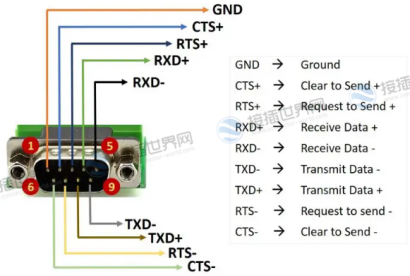
RS485 wired communication technology uses differential signal transmission, determining data logic by the voltage difference between two signal lines, effectively resisting on-site electromagnetic interference. In terms of transmission performance, RS485 supports cable runs of up to 1,200 meters without repeaters, and also supports a master-slave bus topology. A single communication line can connect dozens of devices in series, greatly simplifying on-site wiring, reducing construction costs, and lowering the risk of line faults.
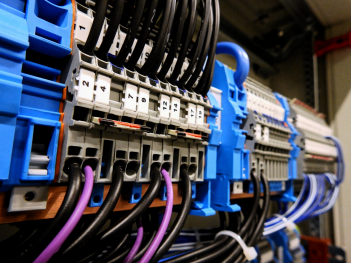
Through this communication link, operation and maintenance personnel can read core operating data in real time — such as voltage, current, operating power, device temperature, and fault codes — and can also remotely modify MPPT tracking parameters, charge/discharge thresholds, and other device configurations, enabling integrated local centralized control within the facility.
Looking across real-world PV project implementations, confusion over RJ45 port functionality and improper use of RS485 communication are common problems, leading to numerous project risks. The most widespread issue is mistaking an RS485-configured RJ45 port for an Ethernet port. Many small project operators and end users, seeing the familiar RJ45 connector, directly plug it into network equipment, only to find that communication fails completely due to protocol incompatibility.
If remote internet access is needed over RS485, direct connection is not possible. An RS485-to-Ethernet gateway must be added to convert the industrial differential signals into standard network signals before they can connect to the local area network and cloud platform. In addition, improper on-site construction can severely affect communication stability. Problems such as failing to install 120-ohm termination resistors on long-distance bus lines, running communication cables in the same conduit as power cables, and low usage of shielded twisted-pair cables can all cause signal reflection, data fluctuation, communication dropouts, and other faults, compromising the normal stable operation of PV monitoring systems.
Proper matching of communication interfaces and transmission solutions is an important part of standardized PV system construction. Looking at real-world application scenarios, the demand for RS485 wired communication varies significantly across PV projects of different scales, making the right selection particularly critical.
For large ground-mount power plants and utility-scale commercial PV projects of 100kW and above, equipment is densely concentrated and numerous, professional operation and maintenance teams are in place, and integration with plant SCADA, PLC, and other automation control systems is required. RJ45-type RS485 interfaces are the optimal choice. Bus topology enables unified management of all plant equipment, and with the addition of a communication gateway, remote operation and maintenance capabilities over the internet can be added, balancing stability and scalability.
For small to medium commercial PV projects and industrial park storage systems in the 10kW to 100kW range, equipment is relatively concentrated and operation and maintenance scenarios are fixed. Standard RS485 interfaces support local small-scale monitoring platforms, meeting routine plant operation and maintenance needs while leaving sufficient compatibility for future expansion and equipment upgrades.
For residential PV and small residential storage systems under 10kW, there are no professional operation and maintenance facilities or on-site wiring conditions. User needs focus on convenient remote monitoring. Wireless cloud monitoring solutions are fully sufficient, and configuring RS485 interfaces should be avoided to prevent cost waste from functional redundancy.
As the industry evolves, upgrading technical understanding is a core driver of quality and efficiency improvement. The long-held misconception that "an RJ45 port is always an Ethernet port" has led many practitioners to overlook the functional differentiation of industrial equipment interfaces and has caused many unnecessary engineering problems.
In fact, physical interface appearance does not define device functionality. RJ45 is simply a common physical carrier. Its transmission characteristics are determined by the device hardware and communication protocol. RS485 wired communication, with its core advantages of high noise immunity, high stability, long-distance transmission, and easy networking, firmly occupies the mainstream position in industrial PV monitoring. The widespread use of the RJ45 interface has further simplified construction processes and reduced operation and maintenance difficulty.